Enjoy 15% off select pet essentials

Why Is My Cat So Anxious at the Groomer? (And What You Can Do)
Fampets Calm
5/22/20265 min read
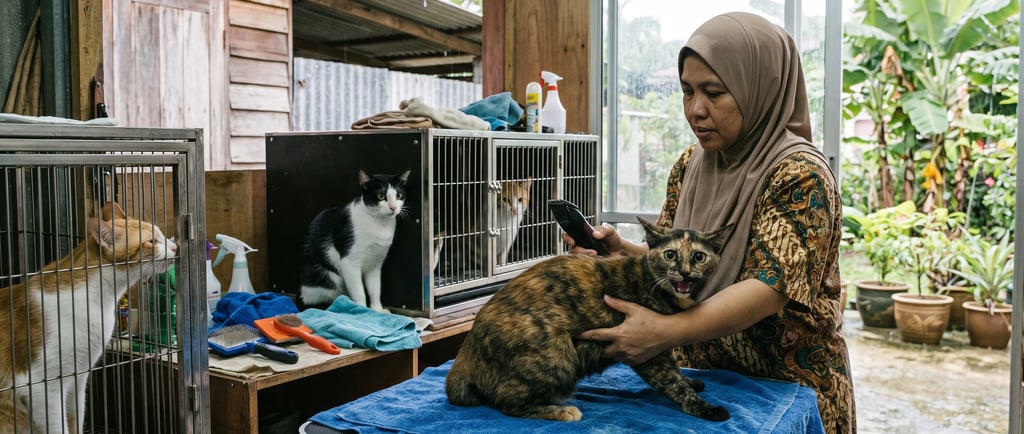
Why Is My Cat So Anxious at the Groomer? (And What You Can Do)
You booked the appointment two weeks ago. You've been mentally preparing yourself. And sure enough, the moment the carrier comes out, your cat disappears under the bed. By the time you get to the groomer, you're sweating, your cat is howling, and the groomer is already giving you that look.
Sound familiar?
Cat grooming anxiety is one of the most common, most frustrating problems Malaysian cat owners deal with. But it's not just your cat being difficult. There are real, biological reasons cats react this way, and once you understand them, the solution becomes obvious.
Why Cats Hate the Groomer, The Real Reason
Cats are hardwired for control. Their sense of safety depends entirely on knowing their environment, their escape routes, and their personal space. The grooming experience violates all three simultaneously:
Unfamiliar smells from other animals, cleaning products, and strangers trigger immediate threat responses
Restraint removes their ability to flee, which is a cat's primary defence mechanism
Loud equipment like dryers and clippers overwhelm their highly sensitive hearing
Handling by strangers breaks their personal space boundaries in ways they never consented to
The car ride adds motion sickness and disorientation before the grooming even begins
For a cat, a grooming session isn't just unpleasant. At a neurological level, it registers as a genuine threat. Their cortisol (stress hormone) spikes, their fight-or-flight response activates fully, and everything after that is damage control.
This is why telling a cat to "calm down" or holding them more firmly almost always makes things dramatically worse.
The Signs Your Cat Is Genuinely Stressed, Not Just Being Dramatic
Cat owners sometimes dismiss grooming anxiety as attitude or stubbornness. These signs tell you it's physiological stress:
Before the appointment:
✅ Hiding when the carrier appears
✅ Vocalising loudly in the car
✅ Drooling or panting (both signs of acute stress in cats)
✅ Loss of bladder or bowel control
During grooming:
✅ Hissing, scratching, or biting despite normally being gentle
✅ Freezing completely (shutdown, not calm)
✅ Trying to escape continuously throughout the session
✅ Excessive panting or rapid breathing
After returning home:
✅ Hiding for hours
✅ Over-grooming or refusing to eat
✅ Aggression toward other pets or family members
✅ Loose stools or vomiting (stress directly impacts gut function)
If your cat shows several of these signs, they're experiencing genuine anxiety, not attitude. The distinction matters because genuine anxiety needs to be addressed at the neurological level, not just managed behaviourally.
What Most Owners Try (And Why It Only Gets You So Far)
"Getting them used to it" through repeated exposure works for some cats over a very long time, but for highly anxious cats, repeated negative experiences can actually entrench the fear response rather than reduce it.
Towel wrapping or burrito holds reduce the cat's ability to scratch but do nothing to reduce the internal stress response. The cat is still fully panicked, just temporarily immobilised.
Skipping grooming altogether isn't really an option for long-haired breeds. Matted fur causes skin infections, restricts movement, and becomes a welfare issue. Avoiding grooming to avoid stress just trades one problem for another.
Sedation is occasionally appropriate for extreme cases but requires a vet prescription, adds cost and health risk, and isn't practical as a regular solution for every grooming session.
What Actually Works: Reducing the Anxiety Before It Starts
The most effective approach works upstream, before your cat's stress response activates, not after. The goal is to lower their baseline anxiety level so the grooming experience stays below the threshold that triggers full fight-or-flight.
This is exactly where Fampets CALM Support Chews for Cats come in.
Fampets CALM uses natural calming ingredients including L-Theanine, Ashwagandha Extract, Chamomile, and Vitamin B Complex to reduce anxiety at the neurological level, without sedation. Your cat stays fully alert and themselves, just noticeably less reactive to the triggers that would normally send them over the edge.
The key difference between CALM and sedation: sedation suppresses your cat's nervous system. CALM supports it, giving the brain the specific compounds it needs to regulate the stress response naturally.
Here's what a Malaysian cat owner experienced:
"Kucing saya ini memang 'gangster' kalau bab mandi. Dah berapa banyak groomer yang ditolak sebab dia garang sangat. Tapi baru-baru ini saya cuba Fampets CALM untuk bagi dia tenang sikit. Masa hantar grooming hari itu, dia tidak mengamuk macam selalu. Dah tak payah risau kena komplen dengan groomer lagi lepas ini. Sangat disyorkan!"
, Mimi ⭐⭐⭐⭐⭐
How to Use Fampets CALM for Grooming Days
Getting the timing right makes a significant difference:
30–60 minutes before the grooming appointment, give your cat one CALM chew. This allows the active ingredients to absorb and reach effective levels in the bloodstream before the stress triggers begin.
Two easy ways to give it:
Offer directly as a treat, most cats accept the soft chew texture without hesitation
Crumble it over wet food if your cat is suspicious of new things
For cats with severe grooming anxiety, try giving CALM daily for 5–7 days before a scheduled appointment. This builds up a baseline calming effect that makes the single pre-grooming dose even more effective.
4 Grooming Habits That Reduce Anxiety Over Time
CALM handles the neurological side. These habits help reduce the behavioural triggers:
1. Normalise the carrier.
Leave the carrier out in your home permanently with a familiar blanket inside. When the carrier is always present, it stops being a signal that something stressful is about to happen.
2. Choose a cat-specialist groomer.
Not all groomers are equal. A groomer experienced with anxious cats will use slower movements, lower noise levels, and gentler handling techniques that don't escalate the stress response. In Malaysia, ask specifically whether the groomer has experience with anxious or reactive cats before booking.
3. Book early morning appointments.
Grooming salons are typically quieter in the first hour of the day. Less ambient noise, fewer animals, and a fresher groomer makes a measurable difference for sensitive cats.
4. Keep the car ride calm.
Cover the carrier with a light blanket to reduce visual stimulation during the drive. Spray a small amount of Feliway (a synthetic calming pheromone available at most Malaysian pet shops) inside the carrier 30 minutes before the journey.
For Cats With Year-Round Anxiety
If your cat's anxiety extends beyond grooming, showing up during thunderstorms, fireworks, vet visits, or when strangers visit your home, daily CALM supplementation is worth considering.
Many Malaysian cat owners whose cats have chronic anxiety use Fampets CALM as a permanent part of their daily routine. Daily use builds a consistent baseline of calm that makes individual stressful events, including grooming, significantly easier to manage.
The Bottom Line
Your cat isn't being dramatic at the groomer. They're genuinely scared, and their body is responding to a real threat signal. The fix isn't firmer handling or repeated exposure, it's reducing the anxiety before it escalates.
Given 30–60 minutes before the appointment, Fampets CALM gives your cat's nervous system exactly what it needs to stay below the panic threshold, so grooming day becomes manageable instead of a battle you dread every few weeks.
👉 Try Fampets CALM for Cats, Shop Now
Fampets
Follow us here:
Contact
Any queries
fampetsmsia.os@gmail.com
017-9932899
© 2026. All rights reserved.